
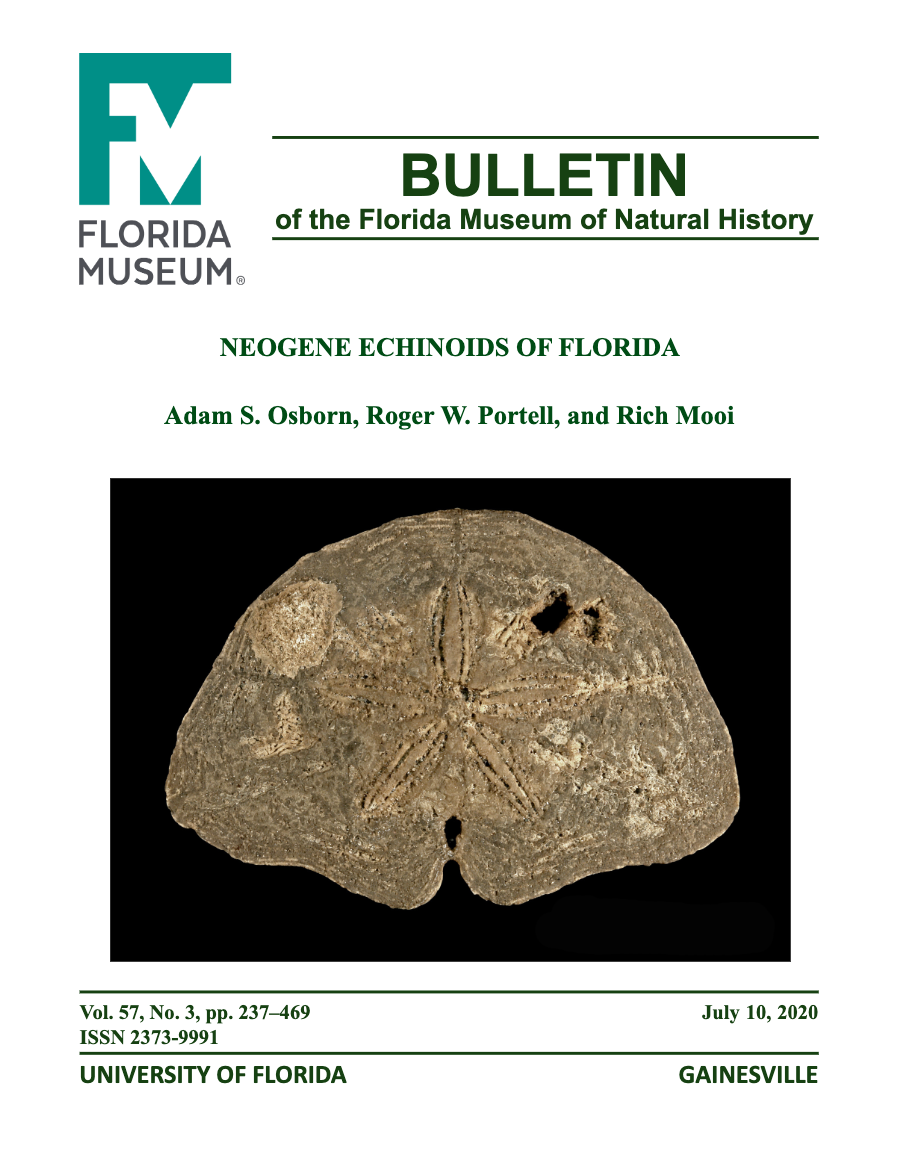
Neogene echinoids of Florida
DOI:
https://doi.org/10.58782/flmnh.gbwl4736Keywords:
Echinoids, Echinoidea, Florida, Neogene, Miocene, Pliocene, Pleistocene, new speciesAbstract
Forty-three species, and five indeterminate taxa of Florida Neogene echinoids are discussed and their geographic and stratigraphic distributions provided. These include 16 species documented from the Pleistocene, 20 from the Pliocene, and 12 from the Miocene. Eight new species are described: Rhyncholampas meansi n. sp. from the Pleistocene; Fernandezaster whisleri n. sp., Genocidaris oyeni n. sp., and Lovenia kerneri n. sp. from the Pliocene; and Clypeaster petersonorum n. sp., Gagaria hunterae n. sp., Brissopsis hoffmani n. sp., and Abertella carlsoni n. sp. from the Miocene. Additionally, we herein recognize Abertella floridana, from the Sopchoppy Limestone, as a species distinct from Abertella aberti, and provide the first documentation of Echinolampas lycopersicus, Rhyncholampas sabistonensis, and Arbia aldrichi from the fossil record of Florida. We update the taxonomy for all referred species and their known distributions. This document is intended to be a compilation of the entire Neogene echinoid record from Florida, which is now understood to have the most speciose and diverse assemblage of Neogene echinoids in the eastern United States.
References
Agassiz, A. 1863. List of echinoderms sent to different institutions in exchange for other specimens. Bulletin of the Museum of Comparative Zoology 1(2):17-28.
Agassiz, A. 1869. Preliminary report on the Echini and starfishes dredged in deep water between Cuba and Florida reef by L. F. De Pourtalès, Assist. U.S. Coast Survey. Bulletin of the Museum of Comparative Zoology 1(9):253-308.
Agassiz, A. 1872-1874. Revision of the Echini. Memoirs of the Museum of Comparative Zoology 3:1-762.
Agassiz, L. 1836. Prodrome d'une monographie des radiaires ou échinodermes. Mémoires de la Société des Sciences Naturelles de Neuchatel 1:168-199.
Agassiz, L. 1838-1842. Monographies d'Échinodermes Vivants et Fossiles. Petitpierre, Neuchatel, 316 p. https://doi.org/10.5962/bhl.title.1833
Agassiz, L., and P. J. E. Desor. 1846-1847. Catalogue raisonné des espèces, des genres, et des familles d'échinides. Annales des Sciences Naturelles, Troisième Série, Zoologie, 6. (1846), 305-374; 7 (1847), 129-168; 8 (1847), 5-35, 355-380.
Allmon, W. D., S. D. Emslie, D. S. Jones, and G. S. Morgan. 1996. Late Neogene oceanographic change along Florida's west coast: evidence and mechanisms. Journal of Geology 104(2):143-162. https://doi.org/10.1086/629811
Alvarado, J. J., L. A. Zeledon, and R. Boyd. 2006. Notas sobre equinodermos fosiles de Costa Rica. Revisita de Biologia Tropical 54 (supplement 1):287-299.
Arnold, B. W., and H. L. Clark. 1927. Jamaican fossil Echini: with description of new species of Cainozoic Echinoidea by H. L. Hawkins. Memoirs of the Museum of Comparative Zoology 50:1-84.
Arnold, B. W., and H. L. Clark. 1934. Some additional fossil echini from Jamaica. Memoirs of the Museum of Comparative Zoology 54(2):139-156.
Arthur, J. D., C. Fischler, C. Kromhout, J. M. Clayton, G. M. Kelley, R. A. Lee, L. Li, M. O'Sullivan, R. C. Green, and C. L. Werner. 2008. Hydrogeologic framework of the Southwest Florida Water Management District. Florida Geological Survey Bulletin 68, 102 p.
Bernasconi, I. 1956. Dos nuevos Equinodermos de la costa del Brasil. Neotropica. 2/8:33-36.
Berry, W. 1941. Pamilco fossil echinoids. U.S. National Museum Proceedings 90(3113): 443-445. https://doi.org/10.5479/si.00963801.90-3113.443
Borghi, E., I. B. Campos, and A. R. Garcia. 2005. Arbacina romana (Merian 1858) from the lower Pleistocene of Faignana Island (Sicily). Parva Naturalia 7:47-71.
Bouve, T. T. 1846. Pygorhynchus gouldii, a new Echinus from the Millstone Grit of Georgia. Proceedings of the Boston Society of Natural History 2:192.
Brewster-Wingard, G. L., T. M. Scott, L. E. Edwards, S. D. Weedman, and K. R. Simmons. 1997. Reinterpretation of the peninsular Florida Oligocene: an integrated stratigraphic approach. Sedimentary Geology 108:207-228. https://doi.org/10.1016/S0037-0738(96)00055-3
Bronn, H. G. 1860. Die Klassen und Ordnungen des Thier-Reichs, wissenschaftlich dargestellt in Wort und Bild. Zweiter Band, Actinozoen. C. F. Winter'sche, Leipzig, 434 p. https://doi.org/10.5962/bhl.title.11639
Bryant, J. D., B. J. MacFadden, and P. A. Mueller. 1992. Improved chronologic resolution of the Hawthorn and Alum Bluff groups in northern Florida: Implications for Miocene chronostratigraphy. Geological Society of America Bulletin 104:208-218. https://doi.org/10.1130/0016-7606%281992%29104%3C0208%3AICROTH%3E2.3.CO%3B2
Campbell, D. C. 1987. New location and range extension for the fossil sand dollar Encope macrophora. Bulletin of the South Carolina Academy of Science 49:18-19.
Campbell, M. R., and L. D. Campbell. 1995. Preliminary biostratigraphy and molluscan fauna of the Goose Creek Limestone of eastern South Carolina. Tulane Studies in Geology and Paleontology 27:53-100.
Carter, B. D. 1987. Paleogene echinoid distributions in the Atlantic and Gulf coastal plains. Palaios 2:390-404. https://doi.org/10.2307/3514764
Carter, B. D. 1990. Late Eocene echinoid biofacies of Florida. Palaios 5:176-183. https://doi.org/10.2307/3514814
Carter, B. D., and T. H. Beisel. 1987. "Cassidulus" trojanus belongs in the genus Eurhodia (Echinoidea) based upon new criteria. Journal of Paleontology 61(5):1080-1083. https://doi.org/10.1017/S0022336000029425
Carter, B. D., T. H. Beisel, W. B. Branch, and C. M. Mashburn. 1989. Substrate preferences of late Eocene (Priabonian, Jacksonian) echinoids of the eastern Gulf Coast. Journal of Paleontology 63:495-503. https://doi.org/10.1017/S0022336000019715
Carter, B. D., and R. E. Hammack. 1989. Stratigraphic distribution of late Eocene (Priabonian, Jacksonian) echinoids in Georgia: Suggested correlations with Florida and the Carolinas. Palaios 4:86-91. https://doi.org/10.2307/3514735
Carter, B. D., and M. L. McKinney. 1992. Eocene echinoids, the Suwannee Strait, and biogeographic taphonomy. Paleobiology 18(3):299-325. https://doi.org/10.1017/S0094837300010861
Carter, B. D., J. M. Miller, and R. W. Portell. 2008. Environmental correlates to morphological distinction in late Eocene Oligopygus haldemani from Florida. Geological Society of America, Abstracts with Programs 40(4):67.
Caso, M. E., 1951. Los equinoides fosiles del Cenozoico de Mexico. Boletin de la Asociación Mexicana de Géologos Petroleros 3(1-2):57-96.
Caso, M. E., 1956. El genero Clypeaster Lamarck 1801, en el Terciario de Mexico. Instituto de Biologia Mexicana Anales 27(2):487-528. Cerame-Vivas, M. J., and I. E. Gray, 1964. The presence of a sixth lunule in the sand dollar Mellita quinquiesperforata. Bulletin of Marine Science 14(2):303-305.
Chaney, D. S. 1989. Mold making with room temperature vulcanizing silicone rubber. Pp. 275-331 in R. M. Feldmann, R. E. Chapman, and J. T. Hanibel, eds. Paleotechniques. The Paleontological Society Special Publication 4, Department of Geological Sciences, University of Tenneessee, Knoxville. https://doi.org/10.1017/S2475262200005268
Chesher, R. H. 1963. The morphology and function of the frontal ambulacrum of Moira atropos (Echinoidea: Spatangoida). Bulletin of Marine Science of the Gulf and Caribbean 13: 549-573.
Ciampaglio, C. N., A. S. Osborn, and P.G. Weaver. 2009. A new species of Plagiobrissus from the early late Pliocene (Piacenzian) Goose Creek Limestone of northeastern South Carolina. Southeastern Geology 46(4):201-210.
Ciampaglio, C. N., and A. S. Osborn. 2011. A new species of Schizaster (Echinoidea, Spatangoida) from the late Pliocene (Piacenzian) Intracoastal Formation of Liberty County, Florida. Southeastern Geology 48(2):95-102.
Clark, A. H. 1954. Echinoderms (other than holothurians) of the Gulf of Mexico. Bulletin U.S. Fish Commission 55:373-379.
Clark, H. L. 1907. The Cidaridae. Bulletin of the Museum of Comparative Zoology. 51(7):163-230.
Clark, H. L. 1912. Hawaiian and other Pacific Echini: The Pedinidae, Phymosomatidae, Stomopneustidae, Echinidae, Temnopleuridae, Strongylocentrotidae, and Echinometridae. Memoirs of the Museum of Comparative Zoology 34(4), 180 p. https://doi.org/10.5962/bhl.title.3820
Clark, H. L. 1914. Hawaiian and other Pacific echini: The Clypeastridae, Arachnoididae, Laganidae, Fibulariidae, and Scutellidae. Memoirs of the Museum of Comparative Zoology 46(1), 78 p.
Clark, H. L. 1933. A handbook of the littoral echinoderms of Porto Rico and the other West Indian Islands. New York Academy Science, Scientific Survey of Porto Rico and the Virgin Islands 16(1), 147 p.
Clark, H. L. 1940. A revision of the keyhole urchins (Mellita). U.S. National Museum Proceedings 89(3099):435-444. https://doi.org/10.5479/si.00963801.89-3099.435
Clark, W. B. 1904. Echinodermata. Miocene. Maryland Geological Survey, 430-433.
Clark, W. B., and M. W. Twitchell. 1915. The Mesozoic and Cenozoic Echinodermata of the United States. U.S. Geological Survey, Monograph 54, 341 p. https://doi.org/10.5962/bhl.title.36384
Claus, C. 1880. Grundzüge der Zoologie, 4th ed., vol., 1. Marburg and Leipzig, 822 p.
Conrad, T. A. 1842. Observations on a portion of the Atlantic Tertiary region, with a description of a new species of organic remains. Bulletin of the Proceedings of the National Institute for the Promotion of Science 2:171-194.
Conrad, T. A. 1843a. Description of a new Genus, and of twenty-nine new Miocene, and one Eocene fossil shells of the United States. Proceedings of the Academy of Natural Sciences of Philadelphia 1:305-311.
Conrad, T. A. 1843b. Descriptions of nineteen species of Tertiary fossils of Virginia and North Carolina. Proceedings of the Academy of Natural Sciences of Philadelphia 1:323-328.
Conrad, T. A. 1846. Observations on the Eocene formation of the United States, with descriptions of species of shells, etc., occurring in it. American Journal of Science, series 2, 1(2):209-221.
Conrad, T. A. 1850. Descriptions of one new Cretaceous and seven new Eocene fossils. Proceedings of the Academy of Natural Sciences of Philadelphia 2(2):39-41.
Conrad, T. A. 1865. Descriptions of new species of Echinidae. Proceedings of the Academy of Natural Sciences of Philadelphia 9(2nd ser.), 75 p.
Cooke, C. W. 1941. Cenozoic regular echinoids of eastern United States. Journal of Paleontology 15(1):1-20.
Cooke, C. W. 1942. Cenozoic irregular echinoids of the eastern United States. Journal of Paleontology 16(1):1-62.
Cooke, C. W. 1948. Arbia and Dixieus, two new genera of echinoids. Journal of Paleontology 22(5):606-607.
Cooke, C. W. 1959. Cenozoic echinoids of eastern United States. U.S. Geological Survey Professional Paper 321:1-106, pls. 1-43. https://doi.org/10.3133/pp321
Cooke, C. W. 1961. Cenozoic and Cretaceous echinoids from Trinidad and Venezuela. Smithsonian Miscellaneous Collections 142:1-35.
Cooke, C. W., and S. Mossom. 1929. Geology of Florida. Florida State Geological Survey Annual Report 20:29-228.
Coppard, S. E. 2008. A comparative analysis of the spatangoid echinoid genera Brissopsis and Metalia: a new genus and species of spatangoid (Echinodermata: Echinoidea: Brissopsidae) from the Philippines and the reassignment of Brissopsis persica to Metalia. Zootaxa 1760:1-23. https://doi.org/10.11646/zootaxa.1760.1.1
Coppard, S. E. 2016. A new genus of mellitid sand dollar (Echinoidea: Mellitidae) from the eastern Pacific coast of the Americas. Zootaxa 4111(2):158-166. https://doi.org/10.11646/zootaxa.4111.2.4
Coppard, S. E., K. S. Zigler, and H. A. Lessios. 2013. Phylogeography of the sand dollar genus Mellita: cryptic speciation along the coasts of the Americas. Molecular Phylogenetics and Evolution 69:1033-1042. https://doi.org/10.1016/j.ympev.2013.05.028
Cotteau, G. H. 1875. Description des échinides tertiares des iles St. Barthélemy et Anguilla. Kungliga Svenska Vetenskaps. Akademiens Handlingar (N. F.) 13(6), 47 p.
Cotteau, G. H., and J. Egozcue y Cía. 1897. Descripcion de los equinoides fosiles de la Isla de Cuba. Del Boletín de la Comisión del Mapa Geológico 22, 99 p., 29 pls.
Croft, M., and G. D. Shaak. 1985. Ecology and stratigraphy of the echinoids of the Ocala Limestone (late Eocene). Tulane Studies in Geology and Paleontology 18(4):127-143. Crozier, W. J. 1920. Notes on the bionomics of Mellita. American Naturalist 54:435-442. https://doi.org/10.1086/279775
Cutress, B. M. 1976. A new Prionocidaris (Echinodermata; Echinoidea) from the middle Miocene of Florida. Proccedings of the Biological Society Washington 89:191-198.
Cutress, B. M. 1980. Cretaceous and Tertiary Cidaroida (Echinometra: Echinoidea) of the Caribbean Area. Bulletins of American Paleontology 77(309), 221 p.
Dall, W. H. 1915. A monograph of the molluscan fauna of the Orthaulax pugnax zone of the Oligocene, Tampa, Florida. Bulletin of the U.S. National Museum, 90, 173 p. https://doi.org/10.5479/si.03629236.90.i
Dall, W. H., and G. D. Harris. 1892. Correlation paper-Neocene. U.S. Geological Survey Bulletin 84:85-158.
Dartevelle, E. 1953. Echinides fossils de Congo et de l'Angola, 2e partie. Description systematique des Echinides fossils du Congo et de l'Angola. Annales du Musee Royal de Congo Belge 13:1-240.
David, B., R. Mooi, and M. Telford. 1995. The ontogenetic basis of Lovén's Rule clarifies homologies of the echinoid peristome. Pp. 155-164 in R. H. Emson, A. B. Smith, and A. C. Campbell, eds. Echinoderm Research 1995, Proceedings of the 4th European Colloquium on Echinoderms, London, A.A. Balkema, Rotterdam.
de Loriol, P. 1887. Notes pour servir à l'étude des échinodermes, 2. Recueil Zoologique Suisse, 4:365-407. https://doi.org/10.5962/p.318231
des Moulins, C. 1835. Premier Mémoire sur les Échinides. Prodrome d'une nouvelle classification de ces animaux. Actes de la Société Linnéenne de Bordeaux 7:167-245.
Desor, E. 1855-1858. Synopsis des échinides fossiles. Reinwald, Paris, lxviii+490 p. https://doi.org/10.5962/bhl.title.10163
Dickerson, R. E., and W. S. W. Kew. 1917. The fauna of a medial Tertiary Formation and the associated horizons of northeastern Mexico. Proceedings of the California Academy of Sciences, series 4, 7:125-156.
Di Martino, E., P. D. Taylor, and R. W. Portell. 2017. Bryozoans from the lower Miocene Chipola Formation, Calhoun County, Florida, USA. Bulletin of the Florida Museum of Natural History 53(4):97-200. https://doi.org/10.58782/flmnh.pgmm1110
Donovan, S. K. 1993. Jamaican Cenozoic echinoids. Pp. 371-412 in R. M. Wright and E. Robinson, eds. Biostratigraphy of Jamaica. Geological Society of America Memoir 182. https://doi.org/10.1130/MEM182-p371
Donovan, S. K. 1994. Some fossil echinoids (Echinodermata) from the Cenozoic of Jamaica, Cuba and Guadalupe. Caribbean Journal of Science 30(3-4):164-170.
Donovan, S. K. 2000. A fore-reef echinoid fauna from the Pleistocene of Barbados. Caribbean Journal of Science 36(3-4):314-320.
Donovan, S. K., and D. Clements. 2002. Taphonomy of large echinoids: Meoma ventricosa (Lamarck) from the Pliocene of South Carolina. Southeastern Geology 41(3):169-176.
Donovan, S. K., H. L. Dixon, R. K. Pickerill, and E. N. Doyle. 1994. Pleistocene echinoid (Echinodermata) fauna from southeast Jamaica. Journal of Paleontology 68(2):351-358. https://doi.org/10.1017/S0022336000022939
Donovan, S. K., and B. J. Embden. 1996. Early Pleistocene echinoids of the Manchioneal Formation, Jamaica. Journal of Paleontology 10(3):485-493. https://doi.org/10.1017/S0022336000038415
Donovan, S. K., and C. M. Gordon. 1993. Echinoid taphonomy and the fossil record: supporting evidence from the Plio-Pleistocene of the Caribbean. Palaios 8:304-306. https://doi.org/10.2307/3515152
Donovan, S. K., and B. Jones. 1994. Pleistocene echinoids (Echinodermata) from Bermuda and Barbados. Proceedings of the Biological Society Washington 107(1):109-113.
Donovan, S. K., and D. N. Lewis. 2009. Paleontological implications of multiple genital pores in the apical system of Eucidaris tribuloides (Lamarck), Recent of Jamaica. Caribbean Journal of Science 45(1):20-24. https://doi.org/10.18475/cjos.v45i1.a5
Donovan, S. K., and R. W. Portell. 1996. Clypeaster lamprus H. L. Clark (Echinodermata: Echinoidea) in the Manchioneal Formation (early Pleistocene) of Jamaica. Caribbean Journal of Science 32(1):83-88.
Donovan, S. K., B. Jones, and D. A. T. Harper. 2016. Neogene echinoids from the Cayman Islands, West Indies: regional implications. Geological Journal 51:864-879. https://doi.org/10.1002/gj.2703
Donovan, S. K., D. N. Lewis, H. Vincent, and I. M. Blackman. 2001. Pleistocene echinoids from Tobago, West Indies. Caribbean Journal of Earth Science 35:1-12.
Donovan, S. K., R. W. Portell, and C. J. Veltcamp. 2005. Lower Miocene echinoderms of Jamaica, West Indies. Scripta Geologica 129:91-135.
DuBar, J. R. 1958. Stratigraphy and paleontology of the late Neogene strata of the Caloosahatchee River area of southern Florida. Florida Geological Survey Bulletin 40, 267 p.
DuBar, J. R. 1962. Neogene biostratigraphy of the Charlotte Harbor area in southwestern Florida. Florida Geological Survey Bulletin 43, 83 p.
DuBar, J. R. 1974. Summary of the Neogene stratigraphy of southern Florida. Pp. 206-231 in R. Q. Oaks and J. R. DuBar, eds. Post Miocene Stratigraphy of the Central and Southern Atlantic Coastal Plain. Utah State University Press, Logan, Utah.
Dubar, J. R., S. S. Dubar, L. W. Ward, and B. W. Blackwelder. 1980. Cenozoic biostratigraphy of the Carolina outer Coastal Plain. Pp. 211-236 in T. L. Neathery, ed. Excursions in Southeastern Geology, Atlanta, Georgia. Geological Society of America Annual Meeting 1:211-236.
Duncan, P. M. 1863. On the fossil corals of the West Indian islands. Part 1, Geological Society of London Quarterly Journal 19:406-458. https://doi.org/10.1144/GSL.JGS.1863.019.01-02.40
Duncan, P. M. 1889. A revision of the genera and great groups of the Echinoidea. Journal of the Linnean Society, Zoology 23:1-311. https://doi.org/10.1111/j.1096-3642.1889.tb01431.x
Durham, J. W. 1953a. Scutellaster and Anorthoscutum. Journal of Paleontology 27:147-149.
Durham, J. W. 1953b. Type species of Scutella. Journal of Paleontology 27:347-352
Durham, J. W. 1955. Classification of clypeasteroid echinoids. University of California Publications in Geological Sciences 31:73-198.
Durham, J. W. 1961. Miocene echinoids from the Valle Central, Costa Rica. Journal of Paleontology 35(3):480-488.
Durham, J. W. 1966. Clypeasteroids. Pp. U450-U491 in R. C. Moore, ed. Treatise of Invertebrate Paleontology, Echinodermata 3. The Geological Society of America and University of Kansas Press.
Ebert, T. A., and D. M. Dexter. 1975. A natural history study of Encope grandis and Mellita grantii, two sand dollars in the northern Gulf of California, Mexico. Marine Biology 32(4):397-407. https://doi.org/10.1007/BF00388997
Emmons, E. 1858. Agriculture of the Eastern Counties; Together with Descriptions of the Fossils of the Marl Beds. North Carolina Geological Survey Report 16, H. D. Turner, Raleigh, xvi+314 p.
Engel, H., 1961. Some fossil clypeastrids (Echinoidea) from Brimstone Hill (St. Kitts) and Sugar Loaf (St. Eustatius, Lesser Antilles). Beaufortia 94(9):1-6.
Fell, H. B., and D. L. Pawson. 1966. Echinacea. Pp. U367-U440 in R. C. Moore (ed.), Treatise on Invertebrate Paleontology, Part U. Echinodermata. 3(2). Geological Society of America and University of Kansas Press.
Fischer, A. G. 1951. The echinoid fauna of the Inglis Member, Moodys Branch Formation. Florida Geological Survey Bulletin 34(2):45-101.
Fischer, A. G. 1966. Spatangoids. Pp. U543-U628 in R. C. Moore, ed. Treatise on Invertebrate Paleontology, Part U, Echinodermata 3(2). Geological Society of America and University of Kansas Press.
Fischer, R. 1985. La fauna de la Formacion Turrucares (Mioceno, Valle Central, Costa Rica). Geologica et Palaeontologica 19:191-225.
Francisco, V. and S. M. Pauls. 2008. Especies del Orden Clypeasteroida (Echinodermata: Echinoidea) de la costas de Venezuela. Revista Biología Tropical 56(3):215-228.
Gardner, J. 1926-1952. The molluscan fauna of the Alum Bluff Group of Florida. U.S. Geological Survey Professional Paper 142 (A-I), 709 p. https://doi.org/10.3133/pp142D
Gauthier, V. 1897. Contribution à l'etude des échinides fossiles, no I-III. Bulletin de la Société géologique de France, ser. 3, 25:831-841.
Gmelin, J. F. 1791. Caroli a Linne, Systema naturae 13th ed. vol. 1, part 6. Lipsiae (Beer), 3021-3910.
Gordon, C. M. 1991. The poor fossil record of Echinometra (Echinodermata: Echinoidea) in the Caribbean region. Journal Geological Society of Jamaica 28:37-41.
Gordon, W. A. 1963. Middle Tertiary echinoids of Puerto Rico. Journal of Paleontology 37(3):628-642.
Grabau, S. M., and H. W. Shimer. 1910. North American Index Fossils: Invertebrates Vol. II. A. G. Seiler & Co., 909 p. https://doi.org/10.5962/bhl.title.52120
Grant, U. S., and L. G. Hertlein. 1938. Brissopsis blanpiedi, a new species of echinoid from the medial Tertiary of Mississippi. American Midland Naturalist 19(2):482-486. https://doi.org/10.2307/2422989
Gray, J. E. 1825. An attempt to divide the Echinida, or sea eggs, into natural families. Annals of Philosophy 10:423-431.
Gray, J. E. 1835. On the genera distinguishable in Echinus. Proceedings of the Zoological Society of London 3:57-60. https://doi.org/10.1111/j.1096-3642.1835.tb01252.x
Gray, J. E. 1851. Description of some new genera and some new species of Scutellidae and Echinolampidae in the collection of the British Museum. Proceedings of the Zoological Society of London 1851:34-38. https://doi.org/10.1111/j.1096-3642.1851.tb01127.x
Gray, J. E. 1855. Catalogue of the Recent Echinoidea, or Sea Eggs, in the Collection of the British Museum. Part 1. Echinida Irregularia. Woodfall and Kindler, London, 69 p.
Green, R. C., W. L. Evans, C. P. Williams, C. Kromhout, and S. W. Bassett. 2012. Text to accompany the geologic map of the USGS Tarpon Springs 30x60 minute quadrangle, central Florida. Florida Geological Survey Open File Report 98, 40 p.
Green, R. C., C. P. Williams, K.M. Campbell, P. W. Bambach, S. W. Hannon, S. Bassett, B. A. Evans III, and D. T. Paul. 2014. Text to accompany the geologic map of the USGS Saint Augustine 30x60 minute quadrangle, northeast Florida. Florida Geological Survey Open File Report 106, 34 p.
Greenstein, B. J. 1991. An integrated study of echinoid taphonomy: predictions for the fossil record of four echinoid families. Palaios 6:519-540. https://doi.org/10.2307/3514916
Greenstein, B. J. 1993a. The effect of life habit on the preservation potential of echinoids. Pp. 55-66 in B. White, ed. Proceedings of the Sixth Symposium on the Geology of the Bahamas.
Greenstein, B. J. 1993b. Is the fossil record of regular echinoids really so poor? A comparison of living and subfossil assemblages. Palaios 8:587-601. https://doi.org/10.2307/3515034
Gregory, J. W. 1900. The Echinoidea. Pp. 282-332 in E. R. Lankester, ed. A Treatise on Zoology. Part III, the Echinodermata. Charles and Adam Black, London.
Guppy, R. J. L. 1866. On Tertiary echinoderms from the West Indies. Geological Society London Quarterly Journal 22:297-301. https://doi.org/10.1144/GSL.JGS.1866.022.01-02.21
Haeckel, E. H. P. A. 1896. Systematische phylogenie Entwurf eines naturlichen Systema der Organismen auf Grund iher Stammesgeschichte. Thome 2. Systematische Phylogenie der Wirbellosen Thiere (Invertebrata). G. Reimer, Ber-lin, 720 p. https://doi.org/10.1515/9783111443935
Harold, A. S., and M. Telford. 1990. Systematics, phylogeny and biogeography of the genus Mellita (Echinoidea: Clypeasteroida). Journal of Natural History 24:987-1026. https://doi.org/10.1080/00222939000770621
Harvey, E. B. 1956. The American Arbacia and Other Sea Urchins. Princeton University Press, Princeton, New Jersey, 298 p. https://doi.org/10.5962/bhl.title.7234
Henderson, R. A. 1975. Cenozoic spatangoid echinoids from New Zealand. New Zealand Geological Survey Paleontological Bulletin 46, 127 p.
Hendler, G., J. E. Miller, D. L. Pawson, and P. M. Kier. 1995. Sea Stars, Sea Urchins and Allies: Echinoderms of Florida and the Caribbean. Smithsonian Institution Press, Washington, DC 390 p.
Herrera, J. C., R. W. Portell, and G. H. Means. 2006. Echinoids of a middle to late Pleistocene deposit from the central Atlantic Coast of Florida. Geological Society of America Abstracts with Programs 38(3):17.
Hoffmeister, J. E., K. W. Stockman, and H. G. Multer. 1967. Miami Limestone of Florida and its recent Bahamian counterpart. Geological Society of America Bulletin 78:175-190. https://doi.org/10.1130/0016-7606%281967%2978%5B175%3AMLOFAI%5D2.0.CO%3B2
Holmes, F. S. 1860. Post-Pleiocene Fossils of South Carolina. Russell & Jones, Charleston, xii+122 p. 28 pls. Echinoids described in fasc. 1, p. 3-6, 1858.
Hopkins, T. S. 1988. A review of the distribution and proposed morphological groupings of extant species of the genus Clypeaster in the Caribbean Sea and Gulf of Mexico. Pp. 337-345 in R. D. Burke, P. V. Mladenov, P. Lambert, and R. L. Parsley, eds. Echinoderm Biology, Proceeding of the 6th International Echinoderm Conference, Victoria, 23-27 August, 1987, Rotterdam, (A. A. Balkema).
Huddlestun, P. F. 1976. The Neogene stratigraphy of the central Florida panhandle. Southeastern Geological Society of America Abstracts with Programs 8(2):203.
Huddleston, P. F. 1988. A revision of the lithostratigraphic units of the Coastal Plain of Georgia. Georgia Geological Survey Bulletin 104, 162 p. Israelsky, M. 1923. Some new forms of West Coast fossil Echinoidea. University of California Bulletin of the Department of Geological Sciences 12(11):377-396.
Israelsky, M. C. 1924. Notes on some echinoids from San Rafael and Tuxpam Beds of the Tampico Region Mexico. Proceedings of the California Academy of Sciences 4:137-145.
Jackson, R. T. 1912. Phylogeny of the Echini with a revision of Paleozoic species. Memoirs of the Boston Society of Natural History 7:1-491. https://doi.org/10.5962/bhl.title.4630
Jackson, R. T. 1917. Fossil Echini of the Panama Canal Zone and Costa Rica. Proceedings of the U.S. National Museum 53:489-501. https://doi.org/10.5479/si.00963801.53-2218.489
Jackson, R. T. 1922. Fossil Echini of the West Indies. Publications of the Carnegie Institution of Washington 306, 104 p. https://doi.org/10.5962/bhl.title.54733
Jackson. R. T. 1927. Studies of Arbacia punctulata and allies and of nonpentamerous Echini. Memoirs of the Boston Society of Natural History 8:433-565.
Jackson, R. T. 1937. Mexican fossil Echini. Proceedings of the U.S. National Museum 84(3015):227-237. https://doi.org/10.5479/si.00963801.84-3015.227
Jeannet, A. 1928. Contribution à l'étude des Echinides tertiaires de la Trinité et du Venezuela. Mémoires de la Société Paléontologique Suisse 48:1-49.
Johnson, R. A. 1993. Paleontology of the upper Pleistocene Anastasia Formation in eastern Florida. Florida Paleontological Society Newsletter 10(3):17-19.
Jones, D. S., P. A. Mueller, D. A. Hodell, and L. A. Stanley. 1993. 87Sr/86Sr Geochronology of Oligocene and Miocene marine strata in Florida. Pp. 15-26 in V. A. Zullo, W. B. Harris, T. M. Scott, and R. W. Portell, eds. The Neogene of Florida and Adjacent Regions, Proceedings of the Third Bald Head Island Conference on Coastal Plains Geology. Florida Geological Survey Special Publication 37.
Jones, D. S. 1997. The marine invertebrate fossil record of Florida. Pp. 89-117 in A. F. Randazzo, and D. S. Jones, eds. The Geology of Florida. University Press of Florida.
Kellum, L. B. 1926. Paleontology and stratigraphy of the Castle Hayne and Trent Marls in North Carolina. U.S. Geological Survey Professional Paper 143, 56p. https://doi.org/10.3133/pp143
Kellum, L. B. 1931. Revision of the names of three fossils from the Castle Hayne and Trent Marls in North Carolina. Journal of the Washington Academy of Sciences 21(4):51-52.
Kier, P. M. 1962. Revision of the cassiduloid echinoids. Smithsonian Miscellaneous Collections 114(3):1-262.
Kier, P. M. 1963. Tertiary echinoids from the Caloosahatchee and Tamiami Formations of Florida. Smithsonian Miscellaneous Collections 145(5):1-63.
Kier, P. M. 1964. Clypeaster romani, new name for C. crassus Kier, 1963 not L. Agassiz 1840. Journal of Paleontology 38(3):610.
Kier, P. M. 1966. Bredin-Archbold-Smithsonian Biological Survey of Dominica. 1. Echinoids of Dominica. Proceedings of the U.S. National Museum 121(3577):1-10. https://doi.org/10.5479/si.00963801.121-3577.1
Kier, P. M. 1972. Upper Miocene echinoids from the Yorktown Formation of Virginia and their environmental significance. Smithsonian Contributions to Paleobiology 3:1-41. https://doi.org/10.5479/si.00810266.13.1
Kier, P. M. 1975. The echinoids of Carrie Bow Cay, Belize. Smithsonian Contributions to Zoology 206:1-45. https://doi.org/10.5479/si.00810282.206
Kier, P. M. 1977. The poor fossil record of the regular echinoid. Paleobiology 3:168-174. https://doi.org/10.1017/S0094837300005248
Kier, P. M. 1983. Upper Cenozoic echinoids from the Lee Creek Mine. Pp. 499-507 in C. E. Ray, ed. Geology and paleontology of the Lee Creek Mine, North Carolina, I. Smithsonian Contributions to Paleobiology 53. https://doi.org/10.5479/si.00810266.53.499
Kier, P. M. 1984. Fossil spatangoid echinoids of Cuba. Smithsonian Contributions to Paleobiology 55:1-336. https://doi.org/10.5479/si.00810266.55.1
Kier, P. M. 1992. Neogene Paleontology in the northern Dominican Republic. the Class Echinoidea (Echinodermata). Bulletins of American Paleontology 102(339):13-40.
Kier, P. M. 1997. Oligocene echinoids of North Carolina. Smithsonian Contributions to Paleobiology 83:1-37. https://doi.org/10.5479/si.00810266.83.1
Kier, P. M., and R. E. Grant. 1965. Echinoid distribution and habits, Key Largo Coral Reef Preserve, Florida. Smithsonian Miscellaneous Collections 149(6):1-68.
Kier, P. M., and M. H. Lawson. 1978. Index of living and fossil echinoids 1924-1970. Smithsonian Contributions to Paleobiology 34:1-182. Kittle, B. A., R. W. Portell, H. G. Lee, and S. W. Roberts. 2013. Mollusca. Nashua Formation (late Pliocene to early Pleistocene). Florida Fossil Invertebrates 15, 40 p. https://doi.org/10.5479/si.00810266.34.1
Kolbe, S. E., R. Lockwood, and G. Hunt. 2011. Does morphological variation buffer against extinction? A test using veneroid bivalves from the Plio-Pleistocene of Florida. Paleobiology 37(3):355-368. https://doi.org/10.1666/09073.1
Kroh, A. 2003. The Echinodermata of the Langhian (lower Badenian) of the Molasse Zone and the northern Vienna Basin (Austria). Annalen des Naturhistorischen Museums in Wien, Serie A 104:155-183.
Kroh, A. 2010. Index of living and fossil echinoids 1971-2008. Annalen des Naturhistorischen Museums in Wien, Serie A 112:195-470.
Kroh, A. 2020. Phylogeny and classification of echinoids. Pp, 1-17 in J. M. Lawrence, ed. Sea urchins: Biology and Ecology, fourth edition, volume 43, Elsevier, Amsterdam. https://doi.org/10.1016/B978-0-12-819570-3.00001-9
Kroh, A., and R. Mooi. 2019. World Echinoidea Database. Accessed at http://www.marinespecies.org/echinoidea on 2019-03-06.
Kroh, A., R. Mooi, C. Del Rio, and C. Neumann. 2013. A new late Cenozoic species of Abertella (Echinoidea: Clypeasteroida) from Patagonia. Zootaxa 3608:369-378. https://doi.org/10.11646/zootaxa.3608.5.5
Kroh, A., and A.B. Smith. 2010. The phylogeny and classification of post-Palaeozoic echinoids. Journal of Systematic Palaeontology 8(2):147-212. https://doi.org/10.1080/14772011003603556
Lamarck, J. B. P. M. d. 1801. Système des animaux sans vertèbres, ou Tableau général des classes, des ordres et des genres des ces animaux, 432 p. Deterville, Paris.
Lamarck, J. B. P. A. de M. 1816. Histoire naturelle des animaux sans vertèbres, présentant les caractères généraux et particuliers de ces animaux, leur distribution, leur classes, leurs families, leur genres et la citation synonymique des principales espéces qui s'y rapportent. 1st edition. 3, 586 p. https://doi.org/10.5962/bhl.title.40014
Lambert, J. 1905. Notes sur quelques Échinides éocèniques de l'Aude et de l'Hérault. Pp. 129-164 in L. Doncieux, ed. Catalogue descriptif des fossils nummulitiques de l'Aude et de l'Hérault. Annales de l'Université de Lyon, Nouvelle Série, l. Sciences, Médicine 17.
Lambert, J. 1922. Nouvelles Observations sur quelques Echinides neogenes de Isle d'Anguilla. The Annals and Magazine of Natural History 9(9):587-596. https://doi.org/10.1080/00222932208632713
Lambert, J., and P. Thiéry. 1909-1925. Essai de Nomenclature Raisonnée des Echinides. L. Ferrière, Chaumont, fasc. 1: i-iii, 1-80, pls 1-2 (March 1909); fasc. 2: 81-160, pls 3-4 (July 1910) https://doi.org/10.1002/prac.19100810108; fasc. 3: 161-240, pls 5-6 (May 1911); fasc. 4: 241-320, pls 7-8 (March 1914) https://doi.org/10.1080/00253359.1914.10654839; fasc. 5: 321-384, pl. 9 (Sept. 1921); fasc. 6-7: 385-512, pls 10-11, 14 (Dec. 1924); fasc. 7-8:513-607, pls 12, 13, 15 (Feb. 1925).
Latreille, P. A. 1825. Familles naturelles du règne animal, exposé succinctement et dans un ordre analytique avec l'indication de leurs genres. J.B. Baillière, Paris, 570 p. https://doi.org/10.5962/bhl.title.34914
Lawrence, J. M., J. Herrera, and J. Cobb. 2004. Vertical posture of the clypeasteroid sand dollar Encope michelini. Journal of Marine Biological Association of the United Kingdom 84(2):407-408. https://doi.org/10.1017/S002531540400935Xh
Lawrence, J. M., and C. Y. Tan. 2001. Test damage to the sand dollar Mellita tenuis on the Florida Gulf Coast. Gulf of Mexico Science 2001(1):50-54. https://doi.org/10.18785/goms.1901.05
Leske, N. G. 1778. Additamenta ad Jacobi Theodori Klein naturalem dispositionem Echinodermatum et lucubratiunculam de aculeis echinorum marinorum. Lipsiae, Lepzig, 278 p. https://doi.org/10.5962/bhl.title.11571
Lessios, H. A., B. D. Kessing, D. R. Robertson, and G. Paulay. 1999. Phylogeography of the pantropical sea urchin Eucidaris in relation to land barriers and ocean currents. Evolution 53(3):806-817. https://doi.org/10.1111/j.1558-5646.1999.tb05374.x
Leutze, W. P. 1956. Encope michelini from the Pamilco Formation of Volusia County, Florida. Florida Academy of Science Quarterly Journal 19(1):65-67.
Lewis, D. N. and S. K. Donovan. 2007. A standardized method of describing fossils, using Echinoidea as an example. Scripta Geologica 134:109-118.
Lewis, D. N., S. K. Donovan, and D. Clements. 2006. Morphology of the large Cenozoic spatangoid echinoid Brissus Gray from North and South Carolina. Southeastern Geology 44(3):129-135.
Lewis, J.B., and G. S. Storey. 1984. Differences in morphology and life history traits of the echinoid Echinometra lucunter from different habitats. Marine Ecology Progress Series 15:207-211. https://doi.org/10.3354/meps015207
Linkimer, L., and T. Aguilar. 2000. Estratigrafía sedimentaria. Pp. 43-62 in P. Denyer and S. Kussmaul, eds. Geología de Costa Rica. Tecnológica de Costa Rica, Costa Rica.
Linnaeus, C. 1758. Systema Naturae per regna tria naturae: secundum classes, ordines, genera, species, cum characteribus, differentiis, synonymis, Locis, 10th ed. Stockholm, Laurentius Salvius. https://doi.org/10.5962/bhl.title.542
Lütken, C. F. 1864. Bidrag til Kundskab om Echiniderne. Videnskabelige Meddelelser fra den naturhistoriske Forening i Kjöbenhavn 1863:69-207.
Lyell, C. 1845. On the Miocene Tertiary strata of Maryland, Virginia, and North and South Carolina. Quarterly Journal of the Geological Society of London 1:413-427. https://doi.org/10.1144/GSL.JGS.1845.001.01.90
Madeira, P., A. Kroh, R. Cordeiro, R. Meireles, and S. P. Avila. 2011. The fossil echinoids of Santa Maria Island, Azores (northern Atlantic Ocean). Acta Geologica Polinica 61(3): 243-264.
Maloney, N. J., and O. Macsotay. 1968. Geology of La Tortuga Island, Venezeula. Association of Venezuela Geologia, Mineria, and Petréleo 10(10):265-287.
Mansfield. W. C. 1932. Pliocene fossils from limestone in southern Florida. U.S. Geological Survey Professional Paper 170-D:42-49. https://doi.org/10.3133/pp170D
Mansfield, W. C. 1937. Mollusks of the Tampa and Suwannee limestones of Florida. Florida Geological Survey Bulletin 15, 334 p.
Mansfield, W. C. 1939. Notes on the upper Tertiary and Pleistocene mollusks of peninsular Florida. Florida Geological Survey Bulletin 18, 75 p.
Marchesini Santos, M. E. C. 1958. Equinóides Miocénicos da Formação Pirabas. Departamento Nacional da Produção Mineral, Divisão de Geologia e Mineralogia, Boletim 179:1-24. https://doi.org/10.11606/issn.2526-3862.bffcluspgeologia.1957.121843
Martens, E., 1867. Über ostasiatische Echinodermen. Archuiv für Naturgeschichte 33(1):106-119. https://doi.org/10.5962/bhl.part.20475
Martinez, S., and R. Mooi. 2005. Extinct and extant sand dollars (Clypeasteroida: Echinoidea) from Uruguay. Revista de Biología Tropical 53(3):1-7.
Maury, C. J. 1934a. Fossil Invertebrata from northeastern Brazil. Bulletin of the American Museum Natural History LXVII (IV): 152-157.
Maury, C. J. 1934b. Lovenilampas, A new echinoidean genus from the Cretaceous of Brazil. American Museum Novitates 744:1-5.
McCrady, J. 1859. Remarks on the Eocene formation in the neighborhood of Alligator, Florida. Proceedings of the Elliott Society of Natural History, Charleston, South Carolina 1:282-283.
McKinney, M. L. 1984. Allometry and heterochrony in an Eocene echinoid lineage: morphological change as a by-product of size selection. Paleobiology 10:407-419. https://doi.org/10.1017/S0094837300008423
McKinney, M. L. 1985. The abundant occurrence of the middle Miocene sand dollar Abertella aberti in the Hawthorn Formation of Florida. Southeastern Geology 25:155-158.
McKinney, M. L., and D. S. Jones. 1983. Oligopygoid echinoids and the biostratigraphy of the Ocala Limestone of peninsular Florida. Southeastern Geology 23:21-29.
McKinney, M. L., K. J. McNamara, B. D. Carter, and S. K. Donovan. 1992. Evolution of Paleogene echinoids: a global and regional view. Pp. 349-367 in D. R. Prothero and W.A. Berggren, eds. Eocene-Oligocene Climatic and Biotic Evolution. Princeton University Press, Princeton, New Jersey. https://doi.org/10.1515/9781400862924.349
McKinney, M. L. C. W. Oyen, B. D. Carter, and K. Fuellhart. 2014. Geographic shape variation in an Oligocene cassiduloid echinoid (Rhyncholampas gouldii) of the southeastern U.S. South-eastern Geology 50(4):215-219.
McKinney, M. L., and L. G. Zachos. 1986. Echinoids in biostratigraphy and paleoenvironmental reconstruction: A cluster analysis from the Eocene Gulf Coast (Ocala Limestone). Palaios 2:420-423. https://doi.org/10.2307/3514480
McPherson, B. F. 1968. Contributions to the biology of the sea urchin Eucidaris tribuloides. Bulletin of Marine Science. 18(2):400-443.
Meek, F. B. 1864. Check list of the invertebrate fossils of North America: Miocene. Smithsonian Miscellaneous Collections 7(7) :1-32. https://doi.org/10.5962/bhl.title.140016
Michelin, H. 1861. Monographie des Clypeastres fossiles. Mémoires de la Société Géoloique de France 7(2):101-148.
Mihaljević, M., C. Klug, O. Aguilera, T. Lüthi, and M. R. Sánchez-Villagra. 2010. Palaeodiversity of Caribbean echinoids including new material from the Venezuelan Neogene. Palaeontologia Electronica 13(3), 36 p.
Mihaljević, M., I. Jerjen, and A. B. Smith. 2011. The test architecture of Clypeaster (Echinoidea; Clypeasteroida) and its phylogenic signature. Zootaxa 2938:21-38.
Missimer, T. M. 1992. Stratigraphic relationships of sediment facies within the Tamiami Formation of southwest Florida: proposed intraformational correlations. Pp. 63-92 in T. M. Scott and W. D. Allmon, eds. The Plio-Pleistocene Stratigraphy and Paleontology of Southern Florida. Florida Geological Survey Special Publication 36.
Missimer, T. M. 1993. Pliocene stratigraphy of southern Florida: unresolved issues of facies correlation in time. Pp. 33-41 in V. A. Zullo, W. B. Harris, T. M. Scott, and R. W. Portell, eds. The Neogene of Florida and Adjacent Regions; Proceedings of the Third Bald Head Island Conference on Coastal Plains Geology. Florida Geological Survey Special Publication 37.
Missimer, T. M. 2001. Late Neogene geology of northwestern Lee County, Florida. Pp. 21-34 in T. M. Missimer and T. M. Scott, eds. Geology and Hydrology of Lee County, Florida (Durward H. Boggess Memorial Symposium). Florida Geological Survey Special Publication 49:21-34.
Missimer, T. M. 2002. Late Oligocene to Pliocene evolution of the central portion of the south Florida platform: mixing of siliclastic and carbonate sediments. Florida Geological Survey Bulletin 65, 184 p.
Missimer, T. M., and S. W. Wise. 2012. Ages of Plio-Pleistocene formations in south Florida based on the revised IUGS boundary age of the lower Pleistocene. Geological Society of America Abstracts with Programs 44(7):607.
Mongiardino-Koch, N., S. E. Coppard, H. A. Lessios, D. E. G. Briggs, R. Mooi, and G. W. Rouse. 2018. A phylogenomic resolution of the sea urchin tree of life. BMC Evolutionary Biology, 18.1 (2018):1-18. https://doi.org/10.1186/s12862-018-1300-4
Mooi, R. 1989. Living and fossil genera of the Clypeasteroidea (Echinoidea: Echinodermata): an illustrated key and annotated checklist. Smithsonian Contributions to Zoology 488:1-51. https://doi.org/10.5479/si.00810282.488
Mooi, R., S. A. Martínez, and C. J. Del Río. 2016. A new South American Miocene species of 'one-holed' sand dollar (Echinoidea: Clypeasteroida: Monophorasteridae). Zootaxa 4173(1):45-54. https://doi.org/10.11646/zootaxa.4173.1.4
Mooi, R., S. A. Martínez, C. J. Del Río, and M. I. F. Ramos. 2017. Late Oligocene-Miocene non-lunulate sand dollars of South America: revision of abertellid taxa and descriptions of two new families, two new genera, and a new species. Zootaxa 4369(3):301-326. https://doi.org/10.11646/zootaxa.4369.3.1
Mooi, R., and D. Peterson. 2000. A new species of Leodia (Clypeasteroida: Echinoidea) from the Neogene of Venezuela and its importance in the phylogeny of mellitid sand dollars. Journal of Paleontology 74(6):1083-1092. https://doi.org/10.1666/0022-3360%282000%29074%3C1083%3AANSOLC%3E2.0.CO%3B2
Moore, H. B. and N. N. Lopez. 1966. The ecology and productivity of Moira atropos. Bulletin of Marine Science. 16(4):648-667.
Mortensen, T. 1903. Echinoidea. The Danish Ingolf Expedition. 4(1) 1903, 193 p., pt 2, 1907, 200 p. Mortensen, T. 1928. A Monograph of the Echinoidea. I. Cidaroidea. C. A. Reitzel & Oxford University Press, Copenhagen & London, 551 p. Mortensen, T. 1935. A Monograph of the Echinoidea. II. Bothriocidaroida, Melonechinoida, Lepidocentroida, and Stirodonta. C. A. Reitzel & Oxford University Press, Copenhagen & London, 647 p. https://doi.org/10.5962/bhl.title.11718
Mortensen, T. 1943. A Monograph of the Echinoidea. III, 3. Camarodonta. II. Echinidae, Strongylocentrotidae, Parasaleniidae, Echinometridae. C. A. Reitzel, Copenhagen, 446 p.
Mortensen, T. 1948. A Monograph of the Echinoidea. IV, 2. Clypeasteroida. Clypeasteridae, Arachnoidae, Fibulariidae, Laganidae and Scutellidae. C. A. Reitzel, Copenhagen, 471 p.
Mortensen, T. 1951. A Monograph of the Echinoidea. V, 2. Spatangoida II. Amphisternata II. Spatangidae, Loveniidae, Pericosmidae, Schizasteridae, Brissidae. C. A. Reitzel, Copenhagen, 593 p.
Morton, S. G. 1834. Synopsis of the organic remains of the Cretaceous group. American Journal of Science 17-18, 88 p.
Muñiz Tirado, A., and R. Mooi. 2018. The hole truth: Evolutionary biology of novel features in keyhole sand dollars from the Pliocene of North America. Integrative and Comparative Biology, 58 (Suppl. 1): e383 DOI: https://doi. org/10.1093/icb/icy002.
Murphy, J. M. 1973. Holocene diagenesis of the Anastasia Formation. Unpublished Master's Thesis, Duke University, Durham, North Carolina, 104 p.
Nebelsick, J.H. and S. Kampfer. 1994. Taphonomy of Clypeaster humilis and Echinodiscus auritus from the Red Sea. Pp. 803-808 in B. David, A. Guille, J. P. Féral, and M. Roux, eds. Echinoderms Through Time, Balkema, Rotterdam. https://doi.org/10.1201/9781003077831-188
Ogg, J. G., G. Ogg, and F. M. Gradstein. 2008. The Concise Geologic Time Scale. Cambridge University Press, Cambridge, 177 p.
Osborn, A. S., and C. N. Ciampaglio. 2010a. A new species of Abertella (Echinoidea, Scutellina) from the late Miocene (Tortonian) Peace River Formation of Hardee County, Florida. Southeastern Geology 47(4):207-217.
Osborn, A. S., and C. N. Ciampaglio. 2010b. New late Pliocene age echinoid fauna of Florida and South Carolina. Geological Society of America Abstracts with Programs 42(2):83.
Osborn, A.S., R. Mooi, and C. N. Ciampaglio. 2013. A new species of Protoscutella (Echinoidea, Clypeasteroida, Protoscutellidae) from the middle Eocene (Lutetian) Santee Limestone in Berkeley County, South Carolina. Southeastern Geology 49(3): 119-131.
Osborn, A. S., and C. N. Ciampaglio. 2014. Rhyncholampas alabamensis (Twitchell) (Echinoidea, Cassidulidae) from the late Oligocene (Chattian) Chickasawhay Limestone of Mississippi and Alabama. Southeastern Geology 50(3):135-143.
Osborn, A. S., R. Mooi, and C. N. Ciampaglio. 2016. Additions to the Eocene echinoid fauna of the southeastern United States, including a new genus and species of prenasterid heart urchin. Southeastern Geology 52(1):33-59.
Oyen, C. W. 2001. Biostratigraphy and diversity patterns of Cenozoic echinoderms from Florida. Unpublished PhD thesis, Geological Sciences, University of Florida, 438 p. https://doi.org/10.5962/bhl.title.117373
Oyen, C. W., K. R. Fountain, R. W. Portell, and G. H. McClellan. 2000. Occurrence of Plio-Pleistocene phosphatized macroinvertebrates from the upper west Florida slope, eastern Gulf of Mexico. Bulletin of the Florida Museum of Natural History 42(5):219-252. https://doi.org/10.58782/flmnh.mtyz3934
Oyen, C. W., and R. W. Portell. 1993. A review and update of the biostratigraphic distribution of Cenozoic echinoids in Florida: a new biodiversity pattern. Geological Society of America, Southeastern Section Abstracts with Program 25(4):60.
Oyen, C. W., and R. W. Portell. 1996. A new species of Rhyncholampas (Echinoidea: Cassidulidae) from the Chipola Formation: the first confirmed member of the genus from the Miocene of the southeastern U.S.A and the Caribbean. Tulane Studies in Geology and Paleontology 29:59-66.
Oyen, C. W., and R. W. Portell. 1999. Biostratigraphy, paleoecology, and diversity patterns of Cenozoic echinoids from Florida. Cenozoic Paleobiology: the last 65 million years of biotic stasis and change - A symposium in honor of Drs. Harold and Emily Vokes - Abstracts and Program 1:11.
Oyen, C. W., and R. W. Portell. 2001. Diversity patterns and biostratigraphy of Cenozoic echinoderms from Florida. Palaeogeography, Palaeo-climatology, Palaeoecology 166:193-218. https://doi.org/10.1016/S0031-0182(00)00209-1
Pennant, T. 1777. British Zoology, vol. IV. Crustacea. Mollusca. Testacea. B. White, London, 154 p.
Perkins, R. D. 1977. Depositional framework of Pleistocene rocks in south Florida. Pp. 131-198 in P. O. Enos and R. D. Perkins, eds. Qua-ternary Sedimentation in South Florida. Geological Society of America Memoir 147. https://doi.org/10.1130/MEM147-p131
Petuch, E. J. 2002. The Edge of the Fossil Sea. Bailey-Matthews Shell Museum, Sanibel Island, Florida, 80 p.
Petuch, E. J. 2004. Cenozoic Seas: The View from Eastern North America. CRC Press. New York and London, 309 p.
Petuch, E. J., and C. E. Roberts. 2007. The Geology of the Everglades and Adjacent Areas. CRC Press, New York and London, 212 p. https://doi.org/10.1201/9781420045598
Phelan, T. F. 1972. Comments on the echinoid genus Encope and a new subgenus. Proceedings of the Biological Society of Washington 85(8):109-130.
Philippi, R. A. 1845. Beschreibung einiger neuer Echinodermen nebst kritischen Bemerckungen über einige weniger bekannte Arten. Archiv für Naturgeschichte 11:344-359.
Pirkle, F. L., F. J. Rich, J. G. Reynolds, T. A. Zayac, W. A. Pirkle, and R. W. Portell. 2007. The geology, stratigraphy, amd paleontology of Reids, Bells, and Roses Bluffs in northeastern Florida. Guide to field trips - 56th Annual Meeting, southeastern section of the Geological Society of America, 137-151.
Poddubiuk, R. H. 1985. Evolution and adaptation in some Caribbean Oligo-Miocene clypeasters. Pp. 75-80 in B. F. Keegan and B. D. S. O'Connor, eds. Proceedings of the Fifth International Echinoderm Conference 24-29 Sep-tember 1984. https://doi.org/10.1201/9781003079224-10
Pomel, A. 1869. Revue des échinodermes et de leur classification pour servir d'introduction à l'étude des fossiles. Deyrolle, Paris, 67 p.
Pomel, A. 1883. Classification méthodique et Genera des Échinides vivante et fossiles. Thèses présentées a la Faculté des Sciences de Paris 503, A. Jourdan, Alger, 131 p. https://doi.org/10.5962/bhl.title.11272
Pomory, C. M. 2003. A Guide to the shallow water Echinodermata of the Texas Coast. Contributions to Marine Science, Marine Science Institute, University of Texas at Austin 36, 188 p.
Portell, R. W., G. H. Means, and T. M. Scott. 2003. Exceptional preservation and concentration of whole body Ranilia (Decapoda: Raninidae) in the Pliocene Intracoastal Formation of Florida. Geological Society of America Abstracts with Programs 35(1):68-69.
Portell, R. W., and C. W. Oyen. 1997. Occurrence of the regular urchin Eucidaris tribuloides from the Tamiami Formation (Pliocene) of Florida. Tulane Studies in Geology and Paleontology 30:99-104.
Portell, R. W., R. L. Turner, and J. L. Beerensson. 2003. Occurrence of the Atlantic Ghost Crab Ocypode quadrata from the upper Pleistocene to Holocene Anastasia Formation of Florida. Journal of Crustacean Biology 23(3):712-722. Puri, H. S. 1953. Contributions to the study of the Miocene of the Florida panhandle. Florida Geological Survey Bulletin 36, 307 p. https://doi.org/10.1651/C-2340
Radwański, A., M. Górka, and A. Wysocka. 2014. Badenian (middle Miocene) echinoids and starfish from western Ukraine, and their biogeographic and stratigraphic significance. Acta Geologica Polonica 64(2):207-247. https://doi.org/10.2478/agp-2014-0012
Radwański, A., and A. Wysocka. 2001. Mass aggregation of middle Miocene spine-coated echinoids Echinocardium and their integrated ecotaphonomy. Acta Geologica Polonica 51(4):295-316.
Ravenel, E. 1842. Description of two new species of Scutella from South Carolina. Journal of the Academy of Natural Sciences of Philadelphia 8:333-336.
Ravenel, E. 1848. Echinidae, Recent and fossil of South Carolina, Burges and James, Charleston, South Carolina, 4 p. https://doi.org/10.5962/bhl.title.63046
Rice, S. H. 1997. The analysis of ontogenetic trajectories: when a change in size or shape is not heterochrony. Proceedings National Academy of Science 94:907-912. https://doi.org/10.1073/pnas.94.3.907
Rupert, F. R. 1991. The geomorphology and geology of Liberty County, Florida. Florida Geological Survey Open File Report 43, 9 p.
Salsman, G. G., and W. H. Tolbert. 1965. Observations on the sand dollar Mellita quinquies-perforata. Limnology and Oceanography 10(1):152-155. https://doi.org/10.4319/lo.1965.10.1.0152
Sánchez-Roig, M. 1949. Paleontologia Cubana I, Los equinodermos fosiles de Cuba. Compania Editora de Libros y Foiletos, La Habana, 331 p. Sánchez Roig, M. 1951. Faunula de equinodermos fosiles del Terciario de Moron, Provincia de Camaguey: Soc. cubana de historia natural "Felipe Poey" Memoir 20(2):37-64.
Sánchez Roig, M. 1952a. Nuevos geheros y especies de equinoldeos fosiles cubanos: Torreia 17: 18 p.
Sánchez Roig, M. 1952b. Revision de los clypeasteridos cubanos: Revista de Agricultura, p. 118-155.
Sánchez Roig, M. 1953a. Dos nuevos geheros de equinoideos cubanos. Memorias de la Sociedad Cubana de Historia Natural 21(3):257-262.
Sánchez Roig, M. 1953b. Neuvos equinodos fosiles de Cuba. Anales de la Academis de Ciencias Medicas, Fisicas y Naturales de la Habana 91(2):135-176.
Sanford, S. 1909. The topography and geology of southern Florida. Florida Geological Survey Annual Report 2:175-231.
Say, T. 1822. An account of some marine shells of the United States. Journal of the Academy of Natural Sciences of Philadelphia 2(2):221-248.
Say, T. 1827. On the species of the Linnean genus Echinus inhabiting the coast of the United States. Journal of the Academy of Natural Sciences of Philadelphia 5(2):225-229.
Schmidt, W. 1984. Neogene stratigraphy and geologic history of the Apalachicola Embayment, Florida. Florida Geological Survey Bulletin 58, 80 p.
Schmidt, W. 1985. Alum Bluff Liberty County, Florida. Florida Geological Survey Open File Report 9, 11 p. https://doi.org/10.1130/0-8137-5406-2.355
Schneider, C. L., J. Sprinkle, and D. Ryder. 2005. Pennsylvanian (Late Carboniferous) echinoids from the Winchell Formation, northcentral Texas, USA. Journal of Paleontology 79(4):745-762. https://doi.org/10.1666/0022-3360%282005%29079%5B0745%3APLCEFT%5D2.0.CO%3B2
Scott, T. M. 1986. The lithostratigraphic relationships of the Chattahoochee, St. Marks, and Torreya Formations, eastern Florida panhandle. Florida Academy of Sciences, Abstract, Florida Scientist 49, Supplement 1, p. 29.
Scott. T. M. 1988. The lithostratigraphy of the Hawthorn Group (Miocene) of Florida. Florida Geological Survey Bulletin 59, 148 p.
Scott. T. M. 1990. The lithostratigraphy of the Hawthorn Group of peninsular Florida. Florida Geological Survey Open File Report 36:325-336.
Scott, T. M. 1992a. A geological overview of Florida. Florida Geological Survey Open File Report 50, 78 p.
Scott, T. M. 1992b. Coastal Plains stratigraphy: the dichotomy of biostratigraphy and lithostratigraphy a philosophical approach to an old problem: Pp. 21-26 in T. M. Scott and W. D. Allmon, eds. The Plio-Pleistocene Stratigraphy and Paleontology of southern Florida. Florida Geological Survey Special Publications 36.
Scott, T. M. 2002. Notes of the Miocene series of the upper Apalachicola River Valley. Southeastern Geological Society Field Trip Guidebook 42:16-18.
Scott, T. M., K. M. Campbell, F. R. Rupert, J. D. Arthur, T. M. Missimer, J. M. Lloyd, J. W. Yon, and J. G. Duncan. 2001. Geologic map of the state of Florida. Florida Geological Survey Map Series 146.
Scott, T. M. 2001. Text to accompany the geological map of Florida. Florida Geological Survey Open File Report 80, 27 p.
Scott, T. M., and G. L. Wingard. 1995. Facies, fossils and time - a discussion of the litho- and biostratigraphic problems in the Plio-Pleistocene sediments in southern Florida. Unpaginated in T. M. Scott, (compiler). Stratigraphy and paleontology of the Plio-Pleistocene shell beds, southwest Florida: Southeastern Geological Society Guidebook 35.
Seilacher, A. 1979. Constructional morphology of sand dollars. Paleobiology 5:191-221. https://doi.org/10.1017/S0094837300006527
Sellards, E. H. 1912. The soils and other surface residual materials of Florida. Florida Geological Survey Annual Report 4, 79 p.
Sellards, E. H. 1919. Geologic sections across the Everglades of Florida. Florida Geological Survey Annual Report 12:67-76.
Serafy, D. K. 1973. Variation in the polytypic sea urchin Lytechinus variegatus (Lamarck 1816) in the western Atlantic (Echinodermata; Echinoidea). Bulletin of Marine Science 23(3):525-533.
Serafy, D. K. 1979. Echinoids (Echinodermata: Echinoidea). Memoirs of the Hourglass Cruises 5(III), 120 p.
Serafy, D.K., and F. J. Fell. 1985. Marine flora and fauna of the northeastern United States, Echinodermata: Echinoidea. NOAA Technical Report NMFS 33, 27 p.
Smith, A. B. 1980. The structures and arrangement of echinoid tubercles. Philosophical Transactions of the Royal Society of London 289(1033):1-54. https://doi.org/10.1098/rstb.1980.0026
Smith, A. B. 1984. Echinoid Palaeobiology. George Allen and Unwin, London, 190 p.
Smith, A. B., and J. Ghiold. 1982. Roles for holes in sand dollars (Echinoidea): a review of lunule function and evolution. Paleobiology 8(3):242-253. https://doi.org/10.1017/S0094837300006965
Souto, C., R. Mooi, L. Martins, C. Menegola, and C. R. Marshall. 2019. Homoplasy and extinction: the phylogeny of cassiduloid echinoids (Echinodermata). Zoological Journal of the Linnean Society 187:622-660. https://doi.org/10.1093/zoolinnean/zlz060
Stefanini, G. 1911. Osservazioni sulla distribuzione geografica, sulla origini e sulla filogenesi degli Scutellidae. Bolletino della Società Geologica Italiana 30:739-754.
Swigart, J. P., and J. M. Lawrence. 2008. Small-scale distribution of the sand dollars Mellita tenuis and Encope michelini (Clypeasteroida, Echinodermata) off the central Florida Gulf Coast. Gulf of Mexico Science 2008(1):46-55. Telford, M., and R. Mooi. 1986. Resource partitioning by sand dollars in carbonate and siliceous sediments: evidence from podial and particle dimensions. Biological Bulletin (Woods Hole) 171:197-207. https://doi.org/10.18785/goms.2601.05
Telford, M., R. Mooi, and A. S. Harold. 1987. Feeding activities of two species of Clypeaster (Echinoides [sic], Clypeasteroida): further evidence of clypeasteroid resource partitioning. Biological Bulletin (Woods Hole) 172:324-336. https://doi.org/10.2307/1541712
Telford, M., and R. Mooi. 1996. Podial particle picking in Cassidulus caribaearum (Echinodermata: Echinoidea) and the phylogeny of sea urchin feeding mechanisms. Biological Bulletin (Woods Hole) 191:209-223. https://doi.org/10.2307/1542924
Troschel, F. H. 1872. Die Familie der Echinocidariden (1). Archiv für Naturgeschichte 38:293-356.
Tuomey, M., and F. S. Holmes. 1855-1857. Pleiocene fossils of South Carolina, containing descriptions and figures of the Polyparia, Echinodermata and Mollusca, (Echinodermata chapter published in 1855), Russell and Jones, Charleston, South Carolina, 152 p. https://doi.org/10.5962/bhl.title.60986
Upchurch, S. B., R. N. Strom, and M. G. Nuckels. 1982. Silicification of Miocene rocks from central Florida. Pp. 251-284 in T. M. Scott and S. B. Upchurch, eds. Miocene of the Southeastern United States. Florida Geological Survey Special Publication 25.
Valenciennes, A. 1846-1855. Ichtyologie in Dupetit-Thouars, A. A., Voyage autour de monde sure la frégate "La Venus", pendant 1836-1839. Zoologie., Zoophytes, pls. 1-15, Paris, 355 p.
van Phelsum, M. 1774. Brief aan Cornelius Nozeman, over de Gewelvslekken of Zeeegelen, p. 131 (explicaris tabulae I, II).
Vaughan, T. W. 1909. A preliminary report on the geology of Florida. Florida Geological Survey Annual Report 2:28-176.
Vaughan, T. W. 1910. Contribution to the geologic history of the Floridian plateau. Carnegie Institution of Washington Publication 133, 87 p. Veatch, J. O., and L. W. Stephenson. 1911. Preliminary report on the geology of the coastal plain of Georgia. Georgia Geological Survey Bulletin 26, 466 p.
Vernon, R. O., and H. S. Puri. 1964. Geologic map of Florida. Florida Bureau of Geology Map Series 18.
Vokes, E. H. 1989. An overview of the Chipola Formation, northwestern Florida. Tulane Studies in Geology and Paleontology 22:13-24.
Weaver, C. E. 1908. New echinoids from the Tertiary of California. University of California Publications, Bulletin of the Department of Geology 5(17):271-274.
Weaver, P. G., R. A. Webb, and R. E. Chandler. 2006. Additional echinoderms from the PCS (Lee Creek) Phosphate Mine, near Aurora, Beaufort County, North Carolina. Southeastern Geology 44(2):73-83.
Weisbord, N. E. 1969. Some Late Cenozoic Echinoidea from Cabo Blanco, Venezuela. Bulletins of American Paleontology 56(252):277-371.
Weisbord, N. E. 1971. Corals from the Chipola and Jackson Bluff Formations of Florida. Florida Geological Survey Bulletin 53, 100 p.
Weisbord, N. E. 1973. New and little-known corals from the Tampa Formation of Florida. Florida Geological Survey Bulletin 56, 156 p.
Zachos, L. G. 1968. A new echinoid from the Ocala Limestone. Quarterly Journal of the Florida Academy of Sciences 31(3):161-164.
Zachos, L.G., and G. D. Shaak. 1978. Stratigraphic significance of the Tertiary echinoid Eupatagus ingens Zachos. Journal of Paleontology 52:921-927.
Ziegler, A., J. Lenihan, L. G. Zachos, C. Faber, and R. Mooi. 2016. Comparative morphology and phylogenetic significance of Gregory's diverticulum in sand dollars (Echinoidea: Clypeasteroida). Organisms Diversity & Evolution 16(1):141-166. https://doi.org/10.1007/s13127-015-0231-9
Zigler, K.S., and H. A. Lessios. 2004. Speciation on the coasts of the new world: phylogeography and the evolution of bindin in the sea urchin genus Lytechinus. Evolution 58(6):1225-1241. https://doi.org/10.1111/j.0014-3820.2004.tb01702.x
Zullo, V. A., R. F. Kaar, J. W. Durham, and E. C. Allison. 1964. The echinoid genus Salenia in the Eastern Pacific. Palaeontology 7(2):331-346.
Downloads
Additional Files
Published
How to Cite
Issue
Section
License
Copyright (c) 2023 Bulletin of the Florida Museum of Natural History

This work is licensed under a Creative Commons Attribution-NonCommercial 4.0 International License.